
ESOPTIC at WAIC 2026: Connecting the Optical Layer Behind the AI Revolution

From July 17 to 20, 2026, the 2026 World Artificial Intelligence Conference (WAIC 2026) brought together leading technologies, companies, and innovators shaping the next stage of artificial intelligence. As a core exhibition area, the World Expo Exhibition & Convention Center gathered a broad range of cutting-edge AI achievements, while Zhangjiang Science Hall provided a focused environment for exploring the technologies supporting the rapidly expanding AI ecosystem.
At Booth Z1A-107 in the Haike Hall of Zhangjiang Science Hall, ESOPTIC joined this conversation from a perspective that is sometimes less visible in AI discussions, but absolutely essential to their success: high-speed optical connectivity.
From AI Computing to Optical Connectivity
The development of AI infrastructure is pushing data center networks into a new phase.
Large-scale AI training and inference systems are placing increasing demands on bandwidth, latency, power efficiency, and network density. Behind every high-performance GPU cluster, there is a complex optical interconnect architecture responsible for moving massive volumes of data between servers, switches, and computing nodes.
In this environment, optical transceivers, active optical cables, and direct attach cables are no longer simply passive components within a network architecture. They have become an important part of the overall system design.
This was one of the key themes reflected at ESOPTIC's exhibition booth during WAIC 2026.
From 40G to 1.6T, the product portfolio displayed a broad range of optical connectivity solutions designed for different generations of data center and AI infrastructure.
The product lineup included:
· 40G QSFP+ SR4
· 40G QSFP+ LX4
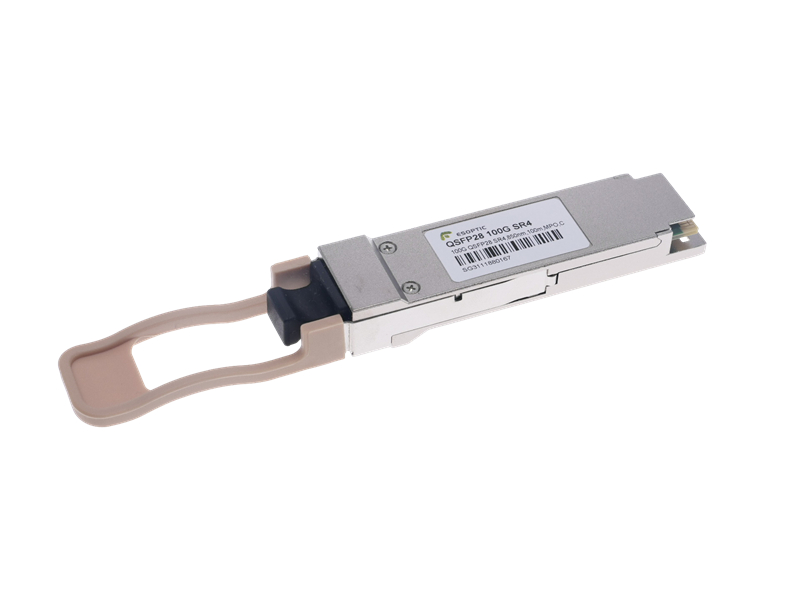
· 100G QSFP28 SR4
· 100G QSFP28 SR4 MDC
· 100G QSFP28 DR1
· 100G QSFP28 CWDM4
· 100G QSFP28 LR4
· 100G QSFP28 ZR4
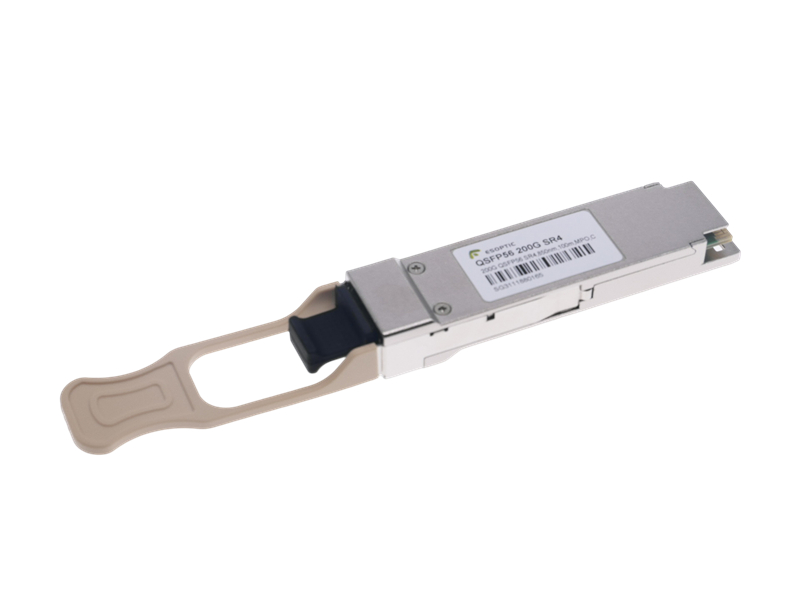
· 200G QSFP56 SR4
· 400G QSFP112 SR4
· 400G QSFP-DD SR4
· 400G QSFP-DD SR8
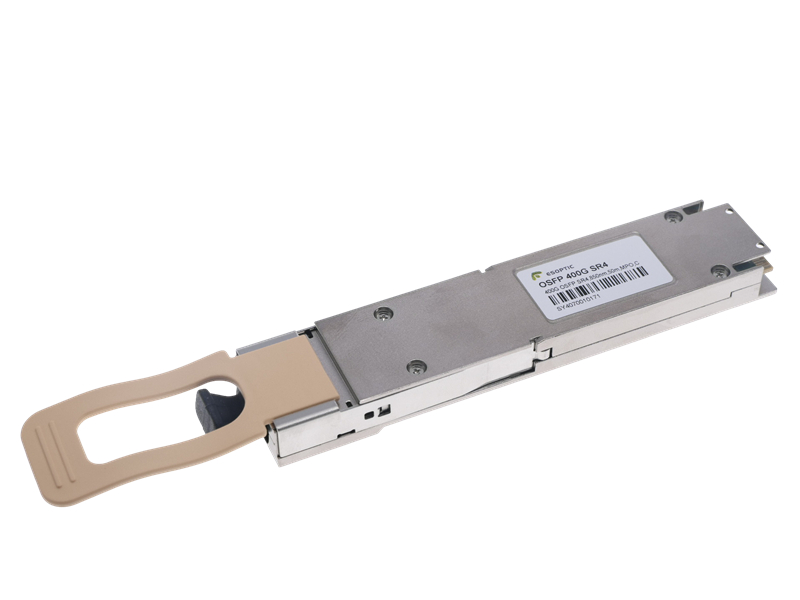
· 400G OSFP SR4
· 400G OSFP DR4
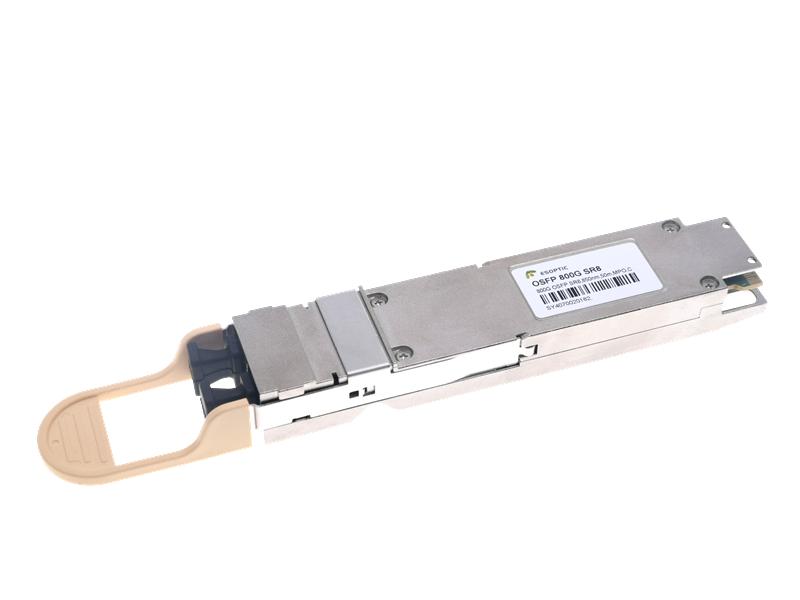
· 800G OSFP SR8
· 800G OSFP DR8
· 1.6T OSFP224 DR8 LPO
· 1.6T OSFP224 DR8
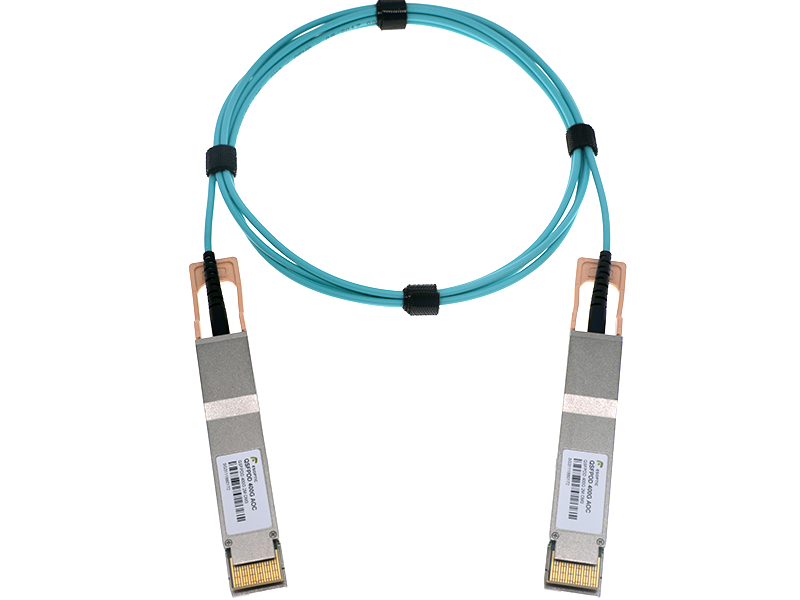
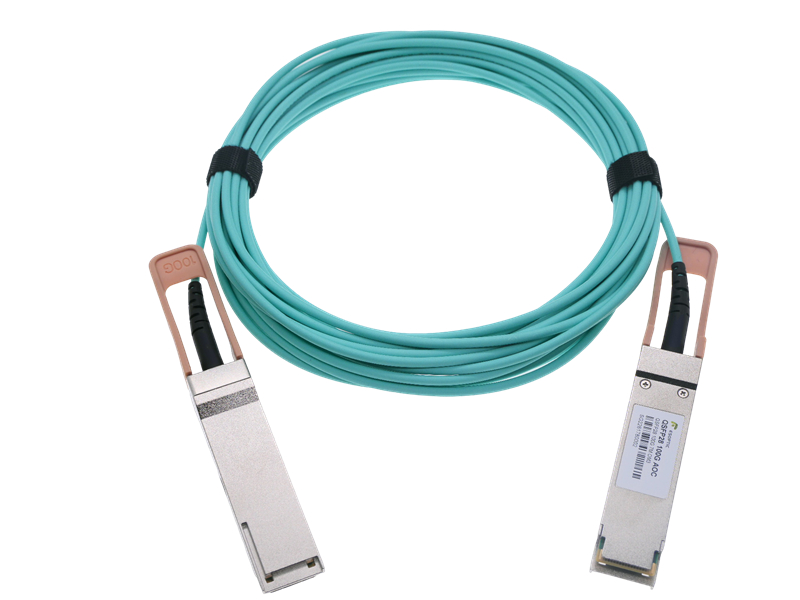
· 100G AOC
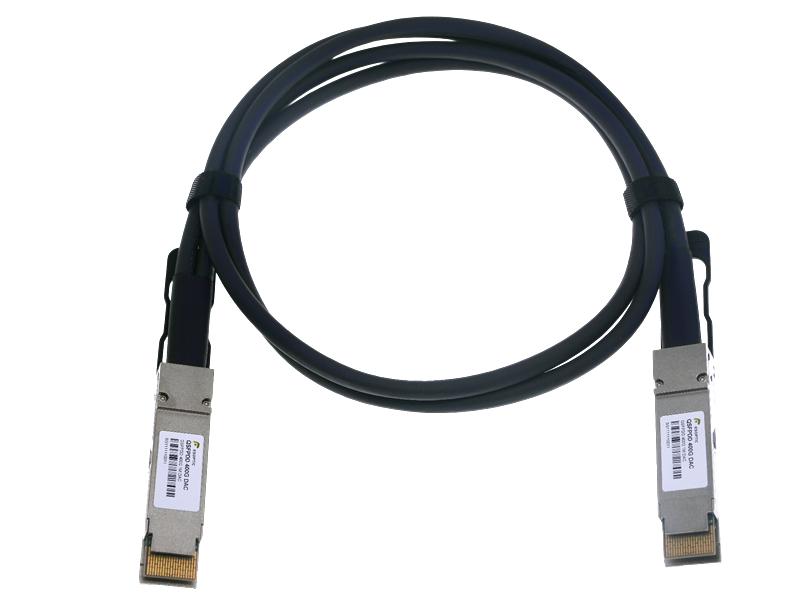
· 400G DAC
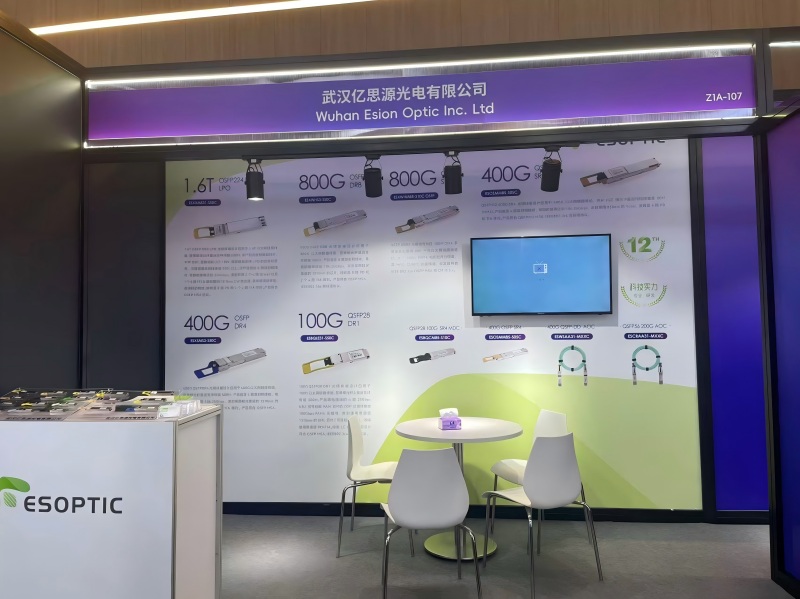
This range covers multiple bandwidth generations, form factors, transmission distances, and application scenarios. More importantly, it reflects the practical evolution of optical interconnect technology—from established 40G and 100G solutions to the high-bandwidth platforms now being developed for next-generation AI clusters.
LPO and the Search for Better Power Efficiency
Power efficiency has become one of the most closely watched topics in AI infrastructure.
As the number of high-speed optical ports continues to increase, the power consumed by optical interconnects can have a direct impact on the overall efficiency of a data center network.
Linear-drive optical technologies, including LPO solutions, have therefore attracted growing attention. By simplifying parts of the optical architecture and reducing dependence on traditional DSP-based designs in specific application scenarios, LPO has the potential to support lower power consumption and shorter system latency.
The 1.6T OSFP224 DR8 LPO solution displayed by ESOPTIC provided an opportunity for visitors to discuss these trends in greater depth.
Of course, no single technology is suitable for every network. The choice between traditional pluggable optics, LPO, and other emerging architectures depends on system design, transmission distance, network topology, power budgets, and application requirements.
The future of optical connectivity will likely be defined not by one technology replacing another, but by different solutions finding the right position within increasingly diverse AI infrastructure.
A Portfolio Built for Different Network Scenarios
High-speed networking does not begin at 800G or 1.6T.
Many data centers continue to operate with multiple generations of network equipment, and different layers of the network often require different optical solutions.
For this reason, ESOPTIC's product portfolio at WAIC 2026 covered a wide range of applications.
40G QSFP+ solutions remain relevant for established network environments and specific short-reach or extended-reach applications. The 100G QSFP28 series offers multiple options, including SR4, SR4 MDC, DR1, CWDM4, LR4, and ZR4, supporting different transmission distances and network architectures.
Moving further into higher-speed connectivity, 200G QSFP56 SR4, 400G QSFP112 SR4, QSFP-DD solutions, and 400G OSFP modules provide a range of options for modern data center deployments.
For 800G and 1.6T systems, OSFP-based solutions are becoming increasingly important as network bandwidth continues to scale.
This broad product coverage is one of the practical strengths of ESOPTIC: rather than focusing on a single speed or form factor, the company continues to build a portfolio that follows the real-world evolution of optical networks.
Beyond Optical Transceivers
Optical modules were not the only solutions on display.
100G AOC and 400G DAC products also attracted attention from visitors looking for practical, high-density interconnect solutions.
In short-distance data center applications, AOCs and DACs can provide a relatively simple and efficient way to connect equipment, particularly in environments where deployment efficiency, cabling simplicity, and cost control are important considerations.
As AI clusters become increasingly dense, the relationship between optical modules, AOCs, DACs, switches, and server architectures is becoming more closely integrated.
The optical layer is no longer an isolated part of the network.
It is becoming part of the overall computing infrastructure.
Three Takeaways from WAIC 2026
Looking back at ESOPTIC's participation in WAIC 2026, several impressions stand out.
1. AI infrastructure is becoming a network engineering challenge
AI performance depends not only on computing power. The ability to move data efficiently between computing nodes is becoming equally important.
As GPU clusters grow larger, the optical network must keep pace with bandwidth, latency, reliability, and power requirements.
2. The optical industry is moving toward higher density and greater efficiency
The transition from 400G to 800G and 1.6T is accelerating. At the same time, technologies such as LPO are bringing new ideas to the design of high-speed optical interconnects.
Higher bandwidth alone is not enough. The next generation of optical solutions must also consider power consumption, thermal performance, system integration, and deployment efficiency.
3. AI and optical communications are becoming increasingly inseparable
The AI industry may be defined by algorithms and computing power, but neither can operate at scale without a high-performance network.
Every model training task, inference request, and distributed computing workload relies on the movement of data.
And behind that movement, optical connectivity plays a critical role.
ESOPTIC: Continuing to Build the Optical Foundation for AI
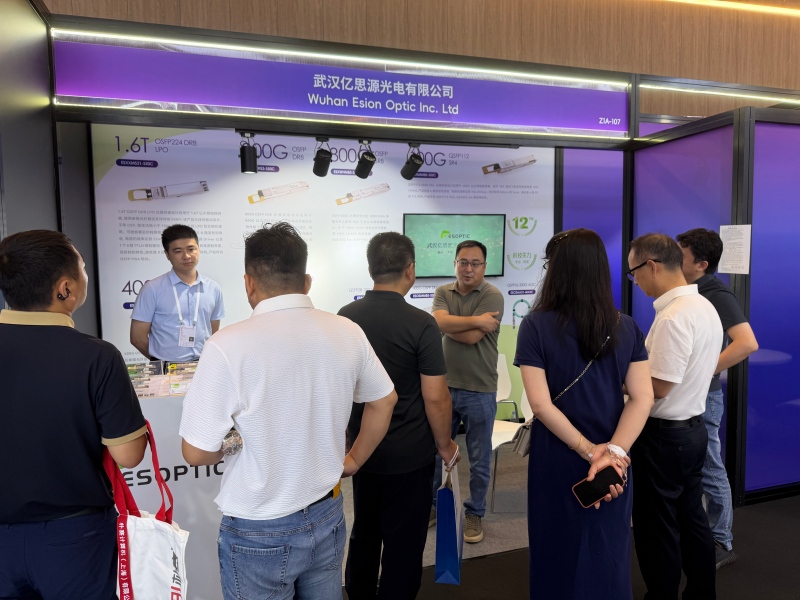
At WAIC 2026, ESOPTIC connected with visitors, partners, and industry professionals from across the AI and communications ecosystem.
The exhibition provided more than an opportunity to showcase products. It also offered a valuable opportunity to observe how quickly the boundaries between AI computing, data center architecture, and optical communications are converging.
From 40G to 1.6T, from traditional pluggable optics to LPO, from optical transceivers to AOCs and DACs, the evolution of connectivity is moving in one clear direction: higher bandwidth, higher density, lower power consumption, and greater system efficiency.
The AI era is still developing.
So is the optical infrastructure behind it.
For ESOPTIC, the next step is clear—continue investing in optical connectivity technologies, expand solutions for high-performance computing and data center networks, and help build the high-speed optical foundation that enables the next generation of intelligent infrastructure.
The AI revolution may happen in the computing layer.
But it moves through the network.
ESOPTIC — Enabling the Optical Connectivity Behind Intelligent Computing.
Frequently Asked Questions
1. What products did ESOPTIC showcase at WAIC 2026?
ESOPTIC showcased optical transceivers and high-speed connectivity products ranging from 40G to 1.6T, including QSFP+, QSFP28, QSFP56, QSFP112, QSFP-DD, OSFP, AOC, and DAC solutions.
2. Why are 800G and 1.6T optical modules important for AI infrastructure?
Large-scale AI clusters require extremely high bandwidth for communication between GPUs, servers, and switches. 800G and 1.6T optical modules help support the increasing bandwidth requirements of next-generation data center networks.
3. What is the role of LPO in high-speed optical connectivity?
LPO, or Linear-drive Pluggable Optics, is designed to simplify certain aspects of the optical interconnect architecture and has the potential to reduce power consumption and latency in suitable application scenarios.
4. Are 40G and 100G optical modules still relevant?
Yes. Different data center environments use different generations of network equipment. 40G and 100G optical modules continue to serve a wide range of existing networks, enterprise applications, access environments, and specific data center scenarios.
5. Why are AOCs and DACs important in AI data centers?
AOCs and DACs can provide efficient short-distance connectivity between servers, switches, and other equipment. They are particularly useful in high-density environments where deployment efficiency and cabling simplicity are important.
